|
THE TABERNACLE
On the High Altar in All Saints' sanctuary sits the tabernacle. The white light denotes that the Blessed Sacrament is reserved there. The sacrament is reserved for the communion of the sick and dying, and also for the devotion of the people. We genuflect to acknowledge that Our Lord is truly present in the Blessed Sacrament, and his presence is there continually in the tabernacle.
There is also a tabernacle on the altar in the Lady Chapel, in which is kept the Holy oils. This tabernacle is used for the Altar of Repose on Maundy Thursday. Tabernacles were one of the gains of the anglocatholic revival in the 19th century. There are a number of requirements for a tabernacle in ancient canon law, as follows.
A TABERNACLE is to be made of metal, preferably lead-lined, and fixed to the altar. This is to guard against vandalism and such dangers as fire. Our tabernacle only has a metal door. The rest is of wood, loosely fitted to the altar.
A TABERNACLE is to be securely locked, and the key kept by the parish priest. This is because of the danger of sacrilege, such as black masses. The present tabernacle key is just a simple filing cabinet type, and the tabernacle can be easily opened.
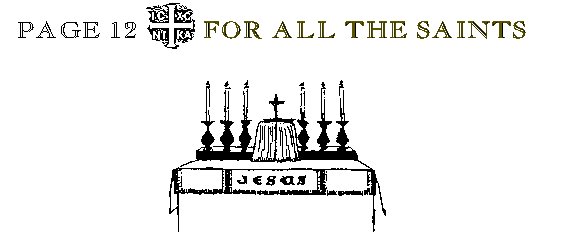
A TABERNACLE should be covered with a veil. This is not only to clothe it appropriately, just as we clothe the altar - it also reminds us of the tabernacle in the wilderness, which was a great tent. For this reason, traditional tabernacles are dome shaped, so that it looks like a tent.
|
|